Category: Skincare devices

LED masks, cleansing brushes, mirrors and facial devices compared.

  • Water Flosser or Interdental Brushes: What Do the Studies Say?

    Water Flosser or Interdental Brushes: What Do the Studies Say?

    This article contains affiliate links. Learn more.
    🗓️ Prices checked on October 29, 2026 · By Svetlana Guseva
    The short answer: if your teeth have gaps a small brush can slide through, interdental brushes are the best-studied place to start: the TePe Original mixed pack costs $8.99 on Amazon.com (checked October 29, 2026, 4.3/5 from 13,364 ratings). If you wear braces, have implants or a bridge, or your teeth are tight, take the Waterpik Aquarius water flosser at $79.95 (4.6/5 from 158,671 ratings).

    Our pick: the TePe Original mixed pack, because it costs $8.99 for 8 color-coded sizes, is rated 4.3/5 from 13,364 ratings, and the two largest reviews we read rank interdental brushes first for gum inflammation (checked October 29, 2026). If a brush will not fit between your teeth, the Waterpik Aquarius at $79.95 is the one to buy.

    Interdental brush or water flosser: who wins, line by line?

    Brushing your teeth does not clean the sides where two teeth touch, so you need a second step. The two most popular are the interdental brush, a tiny bottle brush you slide between teeth, and the water flosser, which sends a pulsing jet of water along the gumline.

    CriterionInterdental brushWater flosserWinner
    Gum inflammation (studies)Ranked 1st of 10 methods (Kotsakis 2018)Ranked 2nd, just behindBrush ✅
    Plaque (Cochrane)May reduce plaque more than brushing alone (low certainty)No reduction shown at 1, 3 or 6 monthsBrush ✅
    Entry price (Oct 29, 2026)$8.99 for 8 brushes (TePe mixed pack)$35.98 (COSLUS C20) to $79.95 (Waterpik Aquarius)Brush ✅
    Braces, implants, bridgePossible where it fits; TePe markets brushes for braces and dental hardwareDedicated tips (7 with the Aquarius)Water flosser ✅
    Very tight teethNever force it: you need a size that slides inThe jet goes everywhereWater flosser ✅
    TravelFits in a pouch; no water, no plugReservoir and charger (the C20 is cordless, USB)Brush ✅
    Two-year cost (our math)$44.95 to $116.87 depending on how often you replace$35.98 to $79.95, tips not countedTie

    Studies: Cochrane review (2019) and the network meta-analysis by Kotsakis et al. (2018), detailed below. Prices checked on Amazon.com on October 29, 2026.

    What do the studies and the ADA say?

    Two syntheses of the research point the same way, and the American Dental Association (ADA) has reviewed one water flosser.

    • The Cochrane review (35 trials) found that interdental brushes might reduce gum inflammation more than string floss at one and three months, and plaque more than brushing alone (low certainty). For water flossers it found a possible drop in gum inflammation at one month, with no effect shown at three or six months and no clear effect on plaque (very low to low certainty).
    • The Kotsakis network meta-analysis (Journal of Periodontology, 2018: 22 trials, 10 methods) ranks interdental brushes first against gum inflammation (64.7% probability of being the best method), the water flosser second (27.4%), and floss and toothpicks last. The authors conclude the choice should fit each person’s situation.
    • The ADA Seal page covers the Waterpik Countertop Family Water Flosser: the ADA found it safe and effective at removing plaque along the gumline and between teeth and at helping to prevent or reduce gingivitis when used as directed. Waterpik’s Amazon listing for the Aquarius cites that Seal.

    In plain terms: both habits are good, the brush starts with a small measured lead, and the water flosser takes the lead where a brush fits badly.

    Three budgets

    Prices, ratings and stock checked on Amazon.com on October 29, 2026; each product has a buy button. Features come from each Amazon listing.

    LevelProductPrice (Oct 29, 2026)Amazon ratingBuy
    Cheapest that holds up · Our pick ✅TePe Original mixed pack (8 brushes, 8 sizes)$8.994.3/5 (13,364 ratings)Amazon
    Best value (water flosser)COSLUS C20 (cordless, 300 ml tank, IPX7)$35.984.4/5 (54,868 ratings)Amazon
    Best quality (water flosser)Waterpik Aquarius (10 settings, 7 tips, 90+ second reservoir)$79.954.6/5 (158,671 ratings)Amazon

    TePe Original mixed pack. Eight color-coded sizes, so you can find the exact size for each gap before you buy a pack of a single size. The listing says the brushes are made in Sweden and designed with dental professionals, and claims they remove “up to 40 percent more plaque than brushing alone”; that is a manufacturer figure we could not check. Sold by TePe Oral Health Care, Inc. and shipped by Amazon.

    COSLUS C20. A cordless, USB-rechargeable water flosser with a 300 ml tank and an IPX7 waterproof rating, according to its listing. Sold by a third-party seller and shipped by Amazon.

    Waterpik Aquarius. The most-reviewed water flosser here (158,671 ratings), with 10 pressure settings, 7 tips, a 22 oz removable reservoir, 90+ seconds of flossing and a 3-year limited warranty, per its listing. Sold and shipped by Amazon.

    Brushes or water flosser: which costs less over two years?

    By crossing today’s Amazon.com prices with the published studies, one point stands out that none of these sources makes on its own: the price advantage of brushes melts away over time, because brushes wear out and get rebought.
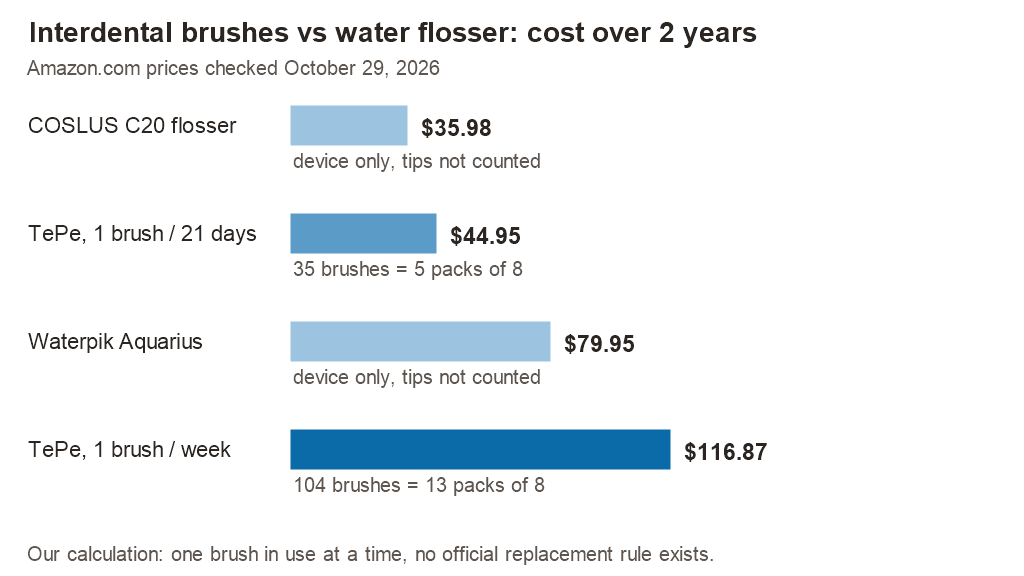
    Chart: two-year cost of TePe interdental brushes ($44.95 to $116.87), COSLUS C20 ($35.98) and Waterpik Aquarius ($79.95), Amazon.com prices checked October 29, 2026
    Our calculation from October 29, 2026 prices, with one brush in use at a time. Water flosser tips are not counted.
    • There is no official replacement rule. Published advice ranges from every few days to several weeks; the only shared sign is bristles that spread apart. We worked out two rhythms.
    • One brush a week: 104 brushes in two years is 13 packs of 8 at $8.99, or $116.87, more than the Waterpik Aquarius ($79.95).
    • One brush every 21 days: 35 brushes is 5 packs, or $44.95, close to the price of the COSLUS C20 ($35.98).
    • The study gap is small. In the Kotsakis analysis the average drop in the gingival index is 0.23 for brushes against 0.19 for a water flosser, while the comfort gap can be large for anyone with braces. The right choice is the one you will do every day.

    Which one for your mouth?

    • Open spaces between teeth, no braces: interdental brushes in the right size. Start with the TePe mixed pack; most mouths need two or three sizes.
    • Braces, implants, crowns or a bridge: a water flosser with dedicated tips, such as the Waterpik Aquarius, plus brushes where they fit. For the full Waterpik story, read our guide Are water flossers worth it?
    • Very tight teeth: if even the smallest brush needs force, don’t force it; a water flosser or string floss takes over.
    • You drop small habits quickly: the water flosser is easier to keep up daily.
    • Who should skip it? If you already clean between your teeth every day and your dentist is happy with your gums, keep your routine. If your gums bleed for weeks or hurt, talk to your dentist first.
    • Next to the basics: a good toothbrush comes first; see our Oral-B iO 9 vs iO 7 comparison.
    Oral health: an interdental brush or a water flosser does not treat disease and we promise no result. Choose a brush that slides in without force, because misuse can hurt your gums. Gums that bleed for a long time, pain, gum disease, braces or implants are good reasons to ask your dentist before you start; the manufacturer’s manual is the final word.
    How we choose

    1. We read the published reviews first, then the listings. 2. We check today’s price, rating and number of ratings. 3. We work out the two-year cost, not just the sticker price.

    Frequently asked questions

    Are interdental brushes better than a water flosser?
    In the studies we read, interdental brushes have a small lead against gum inflammation: the Kotsakis network meta-analysis ranks them first of 10 methods and water flossers second. The Cochrane review says brushes might also reduce plaque more than brushing alone, with low certainty.

    Can a water flosser replace brushing my teeth?
    No. A water flosser or interdental brush goes with your toothbrush, not instead of it. Brushing cleans the surfaces of your teeth; these tools clean between them.

    How often should I replace interdental brushes?
    There is no official rule. Published advice ranges from every few days to several weeks, and the shared sign is bristles that spread apart. At $8.99 for 8, replacing one every 21 days costs about $44.95 over two years, and one a week about $116.87.

    Does the ADA recommend the Waterpik Aquarius?
    The ADA’s Seal page covers the Waterpik Countertop Family Water Flosser, which it found safe and effective at removing plaque along the gumline and between teeth and at helping to prevent or reduce gingivitis, when used as directed. Waterpik’s listing for the Aquarius cites that Seal.

    What if my teeth are too tight for a brush?
    Don’t force one. A water flosser or string floss takes over where the smallest brush does not fit; ask your dentist which size suits each gap.

    Our verdict

    Our pick: the TePe Original mixed pack, because it costs $8.99 for 8 color-coded sizes, is rated 4.3/5 from 13,364 ratings, and interdental brushes rank first against gum inflammation in the largest reviews we read (checked October 29, 2026). Braces, implants or tight teeth? Take the Waterpik Aquarius at $79.95, or the cordless COSLUS C20 at $35.98 for travel. See all of our recommended beauty devices.

  • Are Water Flossers Worth It? Waterpik Aquarius vs Budget Cordless

    Are Water Flossers Worth It? Waterpik Aquarius vs Budget Cordless

    This article contains affiliate links. Learn more.
    🗓️ Prices checked on October 23, 2026 · By Svetlana Guseva
    The short answer: yes, a water flosser is worth it if you want an easier daily habit. The Waterpik Aquarius at $79.95 on Amazon.com (checked October 23, 2026, 4.6/5 from 158,559 ratings) is our pick: 10 pressure settings, a 90-second reservoir and 3-year warranty. On a budget, the cordless COSLUS C20 at $42.99 is the best value.

    Our pick: the Waterpik Aquarius, because its countertop family is the one the ADA has accepted for plaque removal and gingivitis, it has 10 pressure settings and a 90+ second reservoir, and it is rated 4.6/5 from 158,559 ratings on Amazon.com at $79.95 (checked October 23, 2026). For travel or a tighter budget, the COSLUS C20 at $42.99 is cordless and rechargeable.

    Who is a water flosser for?

    A water flosser sends a pulsing stream of water between your teeth and along the gumline. It goes with your toothbrush, not instead of it.

    • You wear braces or have implants, crowns or a bridge: this is where the angled tips earn their keep. The Aquarius comes with 7 tips, according to its listing.
    • String floss never became a habit: a one-minute rinse at the sink is easier to repeat every day.
    • You travel a lot: the COSLUS C20 and C30 are cordless and rechargeable by USB.
    • You are also upgrading your toothbrush: see our Oral-B iO 9 vs iO 7 comparison; the two work well together.

    The three water flossers side by side

    Prices, ratings and stock checked on Amazon.com on October 23, 2026; features as stated in each Amazon listing.

    ModelPrice (Oct 23, 2026)Amazon ratingKey features (listing)Verdict
    COSLUS C30 (cordless)$19.994.4/5 (17,406 ratings)300 ml tank · IPX7 · 4 replacement headsCheapest that holds up ✅ · Amazon
    COSLUS C20 (cordless)$42.994.4/5 (54,720 ratings)300 ml tank · IPX7 · 3 modes · USB chargingBest value ✅ · Amazon
    Waterpik Aquarius (countertop)$79.954.6/5 (158,559 ratings)10 settings · 7 tips · 22 oz reservoir, 90+ seconds · 3-year warrantyOur pick ✅ · Amazon

    Prices, ratings and rating counts checked on Amazon.com on October 23, 2026: all three have a buy button. Features come from each Amazon listing. The Aquarius runs on 120 V and is sold for North America.

    What the listings don’t say: promises, the ADA Seal and cost

    By reading the Amazon listings, the ADA’s Seal page and the Cochrane review side by side, three points stand out that none of them makes on its own.

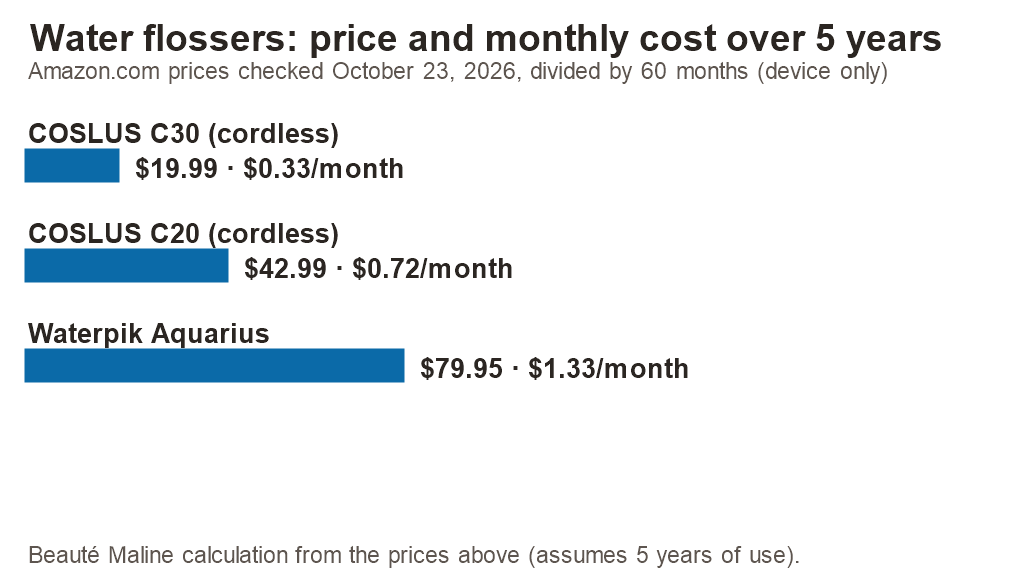
    Chart: price and monthly cost over five years of the COSLUS C30 ($0.33), COSLUS C20 ($0.72) and Waterpik Aquarius ($1.33) water flossers, Amazon.com prices checked October 23, 2026
    Our calculation from October 23, 2026 prices: device price divided by 60 months, replacement tips not counted (assumes five years of use).
    • The promises use three different clocks. The Aquarius listing says it removes “up to 99.9 percent of plaque bacteria from treated areas”, while the COSLUS C20 listing promises “healthier gums in 15 days”. The Cochrane review (5 trials on irrigators) found that the jet might reduce gum inflammation at one month but not at three or six months, with no clear effect on plaque. So buy one for comfort and a daily habit, not for a percentage.
    • The ADA Seal is narrower than the marketing. The ADA’s page covers the Waterpik Countertop Family Water Flosser, and says the council found it safe and effective at removing plaque along the gumline and between teeth and at helping to prevent or reduce gingivitis, when used as directed. The COSLUS C20 title says “ADA Scientific Council Accepted”; the ADA page we read does not mention it, so check the ADA Seal directory yourself before relying on that line.
    • The price gap shrinks over time. Over five years the Aquarius costs $1.33 a month and the C20 $0.72: a $0.62 difference per month for a bigger reservoir, 10 settings and the ADA-reviewed brand.

    Three budgets

    • Best quality: the Waterpik Aquarius, $79.95. 10 settings, 7 tips, a 90+ second reservoir and a 3-year warranty; 4.6/5 from 158,559 ratings.
    • Best value: the COSLUS C20, $42.99. Cordless, rechargeable by USB, 300 ml tank, IPX7; 4.4/5 from 54,720 ratings.
    • Cheapest that holds up: the COSLUS C30, $19.99. 4.4/5 from 17,406 ratings, with 4 replacement heads in the box: an easy way to try the habit.

    Who should skip it? If you already floss every day and your dentist is happy with your gums, you can keep your routine; a water flosser is optional. If your gums bleed for weeks or hurt, talk to your dentist first.

    Oral health: a water flosser does not treat disease and we promise no result. Read the manufacturer’s manual. Gums that bleed for a long time, pain, braces or implants are good reasons to ask your dentist before you start; the manufacturer’s manual is the final word.
    How we choose

    1. We compare today’s price and rating, with the number of ratings.
    2. We work out the monthly cost over five years.
    3. We cross-check the listings, the ADA’s page and a scientific review.

    Frequently asked questions

    Are water flossers worth it?
    For most people they are a good add-on to brushing, especially with braces, implants or bridges. The Cochrane review (35 trials, 3,929 adults) found that oral irrigators might reduce gum inflammation at one month, with no clear effect on plaque; the certainty of the evidence is low to very low.

    Is a water flosser better than string floss?
    In two trials in the Cochrane review, irrigators might reduce gingivitis more than floss in the short term, with low certainty. The best flosser is the one you will actually use every day, and many people find a water flosser easier to stick with.

    Does the ADA recommend the Waterpik?
    The ADA’s Seal page for the Waterpik Countertop Family Water Flosser says the ADA Council on Scientific Affairs found it safe and effective at removing plaque along the gumline and between teeth, and at helping to prevent or reduce gingivitis, when used as directed.

    Which water flosser should I buy for travel?
    The COSLUS C20 at $42.99 on October 23, 2026 is cordless and rechargeable, with a 300 ml tank and an IPX7 waterproof rating, according to its Amazon listing. The COSLUS C30 at $19.99 is the cheaper cordless option.

    Our verdict

    Our pick: the Waterpik Aquarius, because its countertop family carries the ADA’s acceptance, it has 10 settings and a 90+ second reservoir, and it is rated 4.6/5 from 158,559 ratings at $79.95 (checked October 23, 2026). Want to go cordless? Take the COSLUS C20; want to test the habit for the price of a pizza? The COSLUS C30. See all of our recommended beauty devices and, for your skin, our facial cleansing brush guide.

    Sources (October 2026) Method: this review cross-checks published tests, shoppers’ reviews and manufacturer specifications, checked on October 23, 2026. We have not tested these devices ourselves.
  • Are LED Face Masks Worth It? 4 Masks Compared

    Are LED Face Masks Worth It? 4 Masks Compared

    This article contains affiliate links. Learn more.
    🗓️ Prices checked on October 21, 2026 · By Svetlana Guseva
    The short answer: an LED face mask is worth it if you’ll use it a few times a week for at least 4 to 12 weeks, and the one to buy is the Shark CryoGlow ($339.99 on Amazon.com, checked October 21, 2026): FDA-cleared, 4- to 8-minute treatments, built-in under-eye cooling, and 4.4/5 from 1,110 ratings. To try LED therapy for less, the INIA GLOW 4D ($179.98) is a comfortable, cordless start.

    Key points

    • Three lights, three jobs: blue (around 415 nm) targets breakouts; red (around 630 nm) and near-infrared (830 to 850 nm) target fine lines and glow, according to Shark, iRestore and INIA.
    • Results take regular use: Shark’s clinical results come from 12-week studies with 60 and 59 people using the mask once a day; INIA talks about visible results after 4 weeks.
    • Short sessions: 4 to 8 minutes on the Shark, 10 minutes 3 to 5 times a week on the iRestore.
    • Price range on October 21, 2026: from $76.48 (INIA) to $379.00 (iRestore) on Amazon.com.

    Which LED mask for your budget?

    Mask Price (checked Oct 21, 2026) Amazon.com rating What sets it apart (per the listing) Verdict
    Shark CryoGlow
    FW312
    $339.994.4/5 (1,110 ratings)Red, blue and infrared, 4- to 8-minute treatments, under-eye cooling, FDA-clearedOur pick ✅
    INIA GLOW 4D$179.984.4/5 (636 ratings)320 LEDs, dual near-infrared, flexible silicone, cooling eye pad, cordlessBest value ✅
    iRestore Red Light Mask
    360 LEDs
    $379.004.5/5 (1,037 ratings)415, 635 and 830 nm, 10-minute sessions, cordless, US brandTop rated
    INIA Red Light Mask
    220 LEDs
    $76.484.2/5 (1,530 ratings)630 and 850 nm, red and blue, 105 mW/cm² stated, 10/20/30-minute timerBudget pick

    Prices, ratings and stock checked on Amazon.com on October 21, 2026, for delivery to a New York ZIP code: all four were in stock. The Shark is sold and shipped by Amazon.com; the iRestore by iRestore, the two INIA masks by INIA Official US.

    What do the brands really promise, and on what evidence?

    Shark CryoGlow: short treatments and a cool under-eye

    Shark’s Amazon.com listing describes four treatments developed with dermatologists: Better Aging (red and infrared, 6 minutes), Skin Clearing (blue, infrared and red, 8 minutes), Skin Sustain (all three lights, 4 minutes) and Under-Eye Revive, a 5- to 15-minute cooling treatment with 3 chill levels. The mask is FDA-cleared and was tested on 119 participants by an independent third party, says Shark; its fine-line and acne results come from two 12-week studies with 60 and 59 people using it once a day. TechRadar weighed it at about 675 g (1.5 lb). Shark also notes it may be eligible for FSA and HSA spending.

    Best for: anyone who wants a quick routine and doesn’t mind a rigid mask.

    INIA GLOW 4D: the comfortable, cordless middle ground

    Its listing lists 320 LEDs in flexible silicone that follows your face, two near-infrared channels, and four modes (red, blue, amber and combo). A magnetic cooling gel pad soothes puffy eyes, and the mask runs without a cord. INIA doesn’t cite a clinical study of its own.

    Best for: a first LED mask that’s light, flexible and half the Shark’s price.

    iRestore: the best-rated of the four

    iRestore’s listing gives its three wavelengths, red (635 nm), infrared (830 nm) and blue (415 nm), across 360 LEDs, with 10-minute sessions 3 to 5 times a week. Dual straps hold the mask slightly off your face and block direct light from your eyes. It has the highest rating here, 4.5/5 from 1,037 ratings.

    Best for: fine lines and dark spots, if you want a well-reviewed US brand.

    INIA Red Light Mask: the most transparent budget pick

    The least expensive mask is also the most detailed listing: 220 LEDs, 630 nm red and 850 nm near-infrared, blue light, and a stated power output of up to 105 mW/cm². A 2,600 mAh controller offers 10, 20 or 30-minute sessions, 3 to 7 times a week.

    Best for: trying red light therapy for under $80.

    Before your first session

    Skip LED masks if you’re pregnant or breastfeeding, have epilepsy, a light-sensitive skin or eye condition, or take light-sensitizing medication, and keep your eyes protected as your mask’s manual says. If you use retinol or benzoyl peroxide or have a skin condition, ask a dermatologist first; the manufacturer’s manual has the final word.

    Who should skip it

    If you won’t use it at least three times a week, save your money for now: every result the brands cite comes from regular use over weeks. And a mask comes after the basics, cleansing and daily sunscreen, not instead of them.

    What the listings reveal side by side

    Comparing the four Amazon.com listings with TechRadar’s review brings out three points that none of them highlights.

    • LED count isn’t the dose. The listings show 220, 320, 360 or 481 LEDs (Shark), but the dose your skin gets depends on power density (in mW/cm²) and time. Only the cheapest mask, the INIA at $76.48, states its power output. Comparing masks by LED count is like comparing lamps by the number of bulbs without knowing their wattage.
    • Clinical data mostly comes from the brands. Shark is the only one of the four citing its own studies (119 participants, then two 12-week studies); the others rely on the wavelengths they use. That still gives the CryoGlow the strongest file of the group.
    • Battery life depends on the program. TechRadar lists the CryoGlow’s battery among its weak points; the shorter treatments (4 to 8 minutes) stretch a charge further than the long under-eye cooling sessions.
    Mask Cost per session over one year
    INIA Red Light Mask$0.49
    INIA GLOW 4D$1.15
    Shark CryoGlow$2.18
    iRestore$2.43

    Our math: Amazon.com price on October 21, 2026, divided by 156 sessions (3 a week for a year). Electricity not included. Every extra year of use lowers the cost per session.

    How we choose

    1. A mask with published wavelengths and a session plan in writing.

    2. A study cited by the brand, even if the brand funded it, rather than none.

    3. An identifiable seller and a product in stock on the day we check.

    FAQ

    Do LED face masks really work?
    Brands publish studies based on 4 to 12 weeks of regular use, but they run or fund them. The promised effects are visible but modest: an LED mask works alongside sunscreen and a good routine, and doesn’t replace a dermatologist.

    How long is an LED mask session?
    It depends on the mask: 4 to 8 minutes per treatment on the Shark CryoGlow, 10 minutes on the iRestore, and 10, 20 or 30 minutes to choose from on the INIA Red Light Mask.

    Who shouldn’t use an LED face mask?
    People who are pregnant or breastfeeding, people with epilepsy, light-sensitive skin or eye conditions, and anyone taking light-sensitizing medication. If you use retinol or benzoyl peroxide, check with a dermatologist first.

    Does a mask with more LEDs work better?
    Not necessarily. The dose depends on power density (mW/cm²) and session time. Of the four listings we checked on October 21, 2026, only the INIA Red Light Mask states its power output.

    Is the Shark CryoGlow FSA or HSA eligible?
    Shark says it may be, depending on your health plan administrator, who may ask for extra paperwork such as a letter of medical necessity.

    Are LED masks worth it? Our verdict

    If your basics (cleansing, sunscreen) are in place and you’ll stick to a few sessions a week, the Shark CryoGlow ($339.99, checked October 21, 2026) is the strongest choice: FDA-cleared, studies cited, 4- to 8-minute treatments, built-in under-eye cooling, and 4.4/5 from 1,110 ratings. To start for less, the INIA GLOW 4D ($179.98) is light, flexible and cordless. The iRestore ($379.00) is the best-rated of the four, and the INIA Red Light Mask ($76.48) is the easiest way to try red light at home.

    To round out your routine, see our facial cleansing brush guide, and our best lighted makeup mirrors to see your skin clearly in true light. All our picks: Our picks.

    Sources (checked October 2026):

    How we work: this review combines published tests, user feedback and manufacturer specs, checked on October 21, 2026. We did not test these devices ourselves.

  • Oral-B iO 9 vs iO 7: Is the $249.99 iO 9 Worth It?

    Oral-B iO 9 vs iO 7: Is the $249.99 iO 9 Worth It?

    This article contains affiliate links. Learn more.
    🗓️ Prices checked on October 21, 2026 · By Svetlana Guseva
    The short answer: yes, the Oral-B iO 9 is worth it in the US right now. At $249.99 on Amazon.com (checked October 21, 2026, 4.3/5 from 8,191 ratings), it costs just $20 more than the iO 7 and adds a color display, 7 modes, 16-zone 3D tracking, a charging travel case and 2 extra brush heads. On a budget, the iO 2 at $59.99 gives you the same iO brushing for much less.

    Our pick: the Oral-B iO 9, because it’s only $20 more than the iO 7 at $249.99, includes 4 brush heads and a charging travel case, and is the most-reviewed iO on Amazon.com (4.3/5 from 8,191 ratings, sold by Amazon, checked October 21, 2026). If you don’t need a display, the iO 5 at $149.99 is the best value with app tracking.

    What does the extra money actually buy?

    Every Oral-B iO uses the same round head and micro-vibrations. What changes from one model to the next are the extras: number of modes, the display, zone tracking and the travel case.

    • Switching from a manual brush: the iO 2 at $59.99 has 3 modes, including super-sensitive, an automatic pressure sensor and a 2-minute timer.
    • App tracking without a display: the iO 5 at $149.99 has 5 modes, a light-ring timer, a visible pressure sensor, app tracking, 3 brush heads and a travel case.
    • A display on the handle: the iO 7 at $229.99 adds a black-and-white display and 5 modes, with 6-zone tracking in the app, according to ElectricTeeth.
    • Everything: the iO 9 at $249.99 adds a color display, 7 modes, 16-zone 3D tracking and a charging travel case, per ElectricTeeth, plus 4 brush heads in the box.
    • For your face rather than your teeth: see our facial cleansing brush guide or are LED face masks worth it?

    Four Oral-B iO models side by side

    Prices, ratings and stock checked on Amazon.com on October 21, 2026; specs as published by Amazon.com and ElectricTeeth.

    ModelPrice (Oct 21, 2026)Amazon.com ratingModes · trackingVerdict
    Oral-B iO 2 (dark blue)$59.994.3/5 (3,204 ratings)3 modes · pressure sensor, no displayBest budget ✅ · See on Amazon
    Oral-B iO 5 Limited (3 brush heads, case)$149.994.4/5 (4,500 ratings)5 modes · app, light ring, no displayBest value · See on Amazon
    Oral-B iO 7 (2 brush heads, case)$229.994.5/5 (3,549 ratings)5 modes · black-and-white display, 6-zone trackingBest rated · See on Amazon
    Oral-B iO 9 (4 brush heads, charging case)$249.994.3/5 (8,191 ratings)7 modes · color display, 16-zone 3D trackingOur pick ✅ · See on Amazon

    Prices, ratings and review counts checked on Amazon.com on October 21, 2026, for delivery to a New York ZIP code: all four in stock, sold and shipped by Amazon.com. Specs come from each model’s Amazon.com listing and from ElectricTeeth; we did not measure them.

    What reviews don’t tell you: the five-year cost

    Putting the Amazon.com listings next to Test-Achats’ lab test and ElectricTeeth’s comparison brings out three points that none of them highlights on its own.

    ModelBrushExtra heads to buyFive-year total
    iO 2$59.9919 × $7.25$197.74
    iO 5$149.9917 × $7.25$273.24
    iO 7$229.9918 × $7.25$360.49
    iO 9$249.9916 × $7.25$365.99

    Our math from October 21, 2026: 20 brush heads over 5 years (one every 3 months, as Oral-B recommends), at $7.25 each in the 4-pack of iO Ultimate Clean heads ($29.00), minus the heads listed in each offer’s title.

    • Brush heads cost as much as the brush. Whatever handle you pick, 20 heads over five years add up to about $145: from about 32% (iO 9) to 70% (iO 2) of the five-year total.
    • The iO 9 almost pays for its upgrade. Because it comes with 4 heads instead of 2, the iO 9 ends up just $5.50 more than the iO 7 over five years. Versus the iO 2, it’s $168.25 more, or $2.80 a month.
    • No source shows better brushing at $249.99. Test-Achats, the Belgian consumer group (December 18, 2025, 12 models, two labs and 30 volunteers), found that the difference between brushes isn’t in the quality of their brushing and that price climbs mainly with tech features. ElectricTeeth (October 5, 2026) says iO models “clean as well as each other.” What the iO 9 buys you is coaching and convenience, and at $20 over the iO 7, that’s an easy yes.

    Three budgets, three picks

    • Best overall: Oral-B iO 9, $249.99. 7 modes, 16-zone 3D tracking, color display, charging travel case and 4 brush heads, sold by Amazon.
    • Best value: Oral-B iO 5, $149.99. 4.4/5 from 4,500 ratings, 5 modes, app tracking, 3 brush heads and a travel case; no display.
    • Best budget: Oral-B iO 2, $59.99. 4.3/5 from 3,204 ratings, 3 modes including super-sensitive, automatic pressure sensor; no display.

    Who should skip it

    • If you’ll never open the app: 16-zone tracking is the iO 9’s big extra. ElectricTeeth notes you only benefit from smart features if you use them; in that case, the iO 5 or iO 2 brushes the same way.
    • If you weren’t planning on refills: iO handles take iO heads only (4-pack on Amazon), about $29.00 a year at 4 heads.
    Oral health: an electric toothbrush doesn’t treat anything, and we don’t promise results. Read the manufacturer’s manual. Gums that keep bleeding, pain, braces or implants are reasons to ask your dentist before switching brushes.
    How we choose

    1. We compare the day’s price and rating, with the number of reviews.
    2. We work out the five-year cost, brush heads included.
    3. We cross-check listings, an independent lab test and a comparison site.

    To go with your toothbrush, read whether a water flosser is worth it.

    Want to clean between your teeth too? Read water flosser vs interdental brush: which one to choose.

    FAQ

    Which Oral-B iO should I buy?
    The Oral-B iO 9 at $249.99 on October 21, 2026: 4.3/5 from 8,191 Amazon.com ratings, sold by Amazon, with 7 modes, a color display, 16-zone tracking, a charging travel case and 4 brush heads. It’s only $20 more than the iO 7. The iO 5 at $149.99 is the best value, and the iO 2 at $59.99 is the best way to start.

    Does the Oral-B iO 9 clean better than the iO 7?
    No source we read shows that. ElectricTeeth says iO models “clean as well as each other” and that the extra modes don’t change the result. The iO 9 adds 16-zone tracking (6 on the iO 7), 2 more modes, a color display and a charging travel case.

    How much do Oral-B iO brush heads cost?
    The 4-pack of iO Ultimate Clean heads cost $29.00 on October 21, 2026, or $7.25 a head. Oral-B recommends a new head every 3 months, so 4 a year: about $29.00 a year, whichever handle you own.

    Which Oral-B iO is best for sensitive gums or beginners?
    The iO 2 at $59.99: it starts on the super-sensitive setting, and its automatic pressure sensor slows down and lights red when you brush too hard, per its Amazon.com listing. If your gums bleed or hurt, see a dentist; a toothbrush doesn’t treat anything.

    Is the iO 9 worth it over the iO 5?
    If you want the display and 3D tracking, yes: it costs $100 more upfront and about $93 more over five years with brush heads. If you just want a great clean with app coaching, the iO 5 does the job.

    Our verdict

    Our pick: the Oral-B iO 9, because it’s only $20 more than the iO 7 at $249.99, includes 4 brush heads and a charging travel case, and is the most-reviewed iO on Amazon.com (4.3/5 from 8,191 ratings, sold by Amazon, checked October 21, 2026). It’s for anyone who wants the full iO experience: color display, 7 modes and 3D coaching. The iO 5 at $149.99 is the smart value pick, and the iO 2 at $59.99 is the perfect first electric brush. Before Black Friday, keep these prices as the ones to beat: see our Black Friday 2026 beauty device deals. All our picks: Our picks.

    Sources (checked October 2026) How we work: this review combines published tests, user feedback and manufacturer specs, checked on October 21, 2026. We did not test these devices ourselves.
  • Best Lighted Makeup Mirror: 5 LED Mirrors Compared

    Best Lighted Makeup Mirror: 5 LED Mirrors Compared

    This article contains affiliate links. Learn more.
    🗓️ Prices checked on October 21, 2026 · By Svetlana Guseva
    The short answer: the best lighted makeup mirror for everyday foundation is the FUNTOUCH rechargeable makeup mirror, $16.99 on Amazon (checked October 21, 2026), for anyone who wants true-to-life light at home and on the go. It gives you three light colors, three brightness levels and a full 1x face view (5 x 7.5 inches), runs on a rechargeable battery and weighs about 9 oz. For eyeliner and brows, add a 10x mirror such as the LitBear 10X/1X ($23.99).

    Why does the color of light throw off your foundation?

    Color temperature is measured in kelvins (K): the higher the number, the cooler the light looks. The Swiss cantonal energy offices place warm white around 2,700 K, neutral white between 3,000 and 4,000 K, cool white around 5,000 K and daylight above 6,500 K.

    Warm light gilds everything it hits, your complexion included; very cool light makes skin look bluish and dull. In front of the mirror, you end up correcting a flaw that doesn’t exist outdoors: mismatched foundation, heavy blush. The makeup artists interviewed by NBC Select agree: you want light that mimics daylight.

    A second, rarer benchmark is the color rendering index (CRI), scored from 0 to 100, which measures how faithfully colors show up under a light source. Above 80 is considered good, and a 5-point gap is invisible to the eye, according to the LED guide of the Agence culturelle Grand Est, a French regional culture agency.

    Which lighted makeup mirror should you buy?

    Mirror Price (checked Oct. 21, 2026) Amazon.com rating Light · magnification (per the listing) Power Verdict
    FUNTOUCH
    folding, 5 x 7.5 in
    $16.99 4.4/5 (19,109*) 3 light colors, 3 brightness levels · 1x Battery, USB Our pick ✅
    WEILY trifold
    21 LEDs, sold by Amazon
    $19.79 4.4/5 (20,602) Dimmable, no color choice listed · 1x, 2x, 3x 4 AAA batteries (not included) or USB Best for a vanity on a budget
    LitBear 10X/1X
    double-sided
    $23.99 4.5/5 (3,047) 3 light colors, 10 to 100% dimming · 1x and 10x Battery, USB-C Best for detail work
    WEILY 10X/1X
    round, folding
    $21.99 4.0/5 (82) 3 light colors, dimmable · 1x and 10x Battery, USB-C Compact detail mirror
    Ratsamee Hollywood
    15 bulbs, 23 x 18 in
    $49.99 4.4/5 (1,184) 3 light colors, dimmable with memory · detachable 10x magnifier Plug-in, USB-C port Best for a dedicated vanity

    * Ratings shared with other colors or versions on the same listing: they don’t describe this model alone. Ratings read on Amazon.com on October 21, 2026.

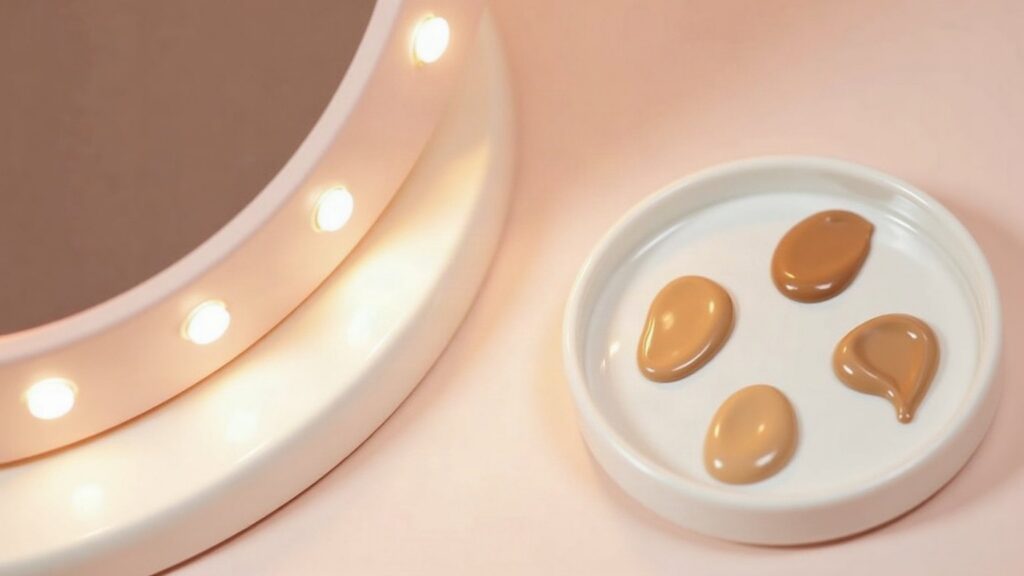
    Close-up of the glowing edge of a mirror and three foundation shades on a ceramic palette

    Which settings really matter?

    • Three light colors, including a neutral one. Do your makeup in neutral light, then switch to warm to check an evening look.
    • Adjustable brightness. According to makeup artist Meredith Boyd (NBC Select), a good mirror lets you adjust it to the light in the room.
    • The right magnification. 1x for foundation, because it shows your whole face; 5x to 10x for eyeliner or brows. Meredith Boyd suggests a mirror of 6 to 8 inches (15 to 20 cm) to see your whole face.
    • Power. A battery for travel, AAA batteries in a pinch (you’ll keep buying them), a cord for a dedicated vanity.
    • Size and stability. A mirror under 1 lb slips into a suitcase; a 23 x 18-inch Hollywood mirror needs a sturdy vanity.

    Each mirror in detail, and who it’s for

    FUNTOUCH: the all-rounder

    The FUNTOUCH rechargeable mirror has what foundation needs: three light colors (white, warm and cool), touch-controlled brightness at 100, 50 or 10%, and a distortion-free 1x mirror of 5 x 7.5 inches. The brand lists 72 LEDs, a 1,000 mAh rechargeable battery and 261 g (about 9 oz), in a slim folding case the size of an iPad mini. FUNTOUCH asks you to charge it with a standard 5V/1A phone charger, not a fast charger. $16.99 (checked October 21, 2026), sold by Amazon. Its 19,109 ratings are shared with other colors of the same listing.

    WEILY trifold: the budget vanity mirror

    The WEILY trifold mirror gives you three panels, 1x in the center and 2x and 3x on the wings, 21 LEDs with touch dimming, 180° rotation and a tray in the base for jewelry. It runs on four AAA batteries (not included) or a USB cable; it doesn’t store a charge. The listing doesn’t offer a choice of light color, so check your foundation by a window too. $19.79 (checked October 21, 2026).

    LitBear 10X/1X: for brows and eyeliner

    The LitBear double-sided mirror pairs a 1x side and a 10x side with 56 LEDs, three light colors and dimming from 10 to 100% with brightness memory and a 30-minute auto-off. A 1,500 mAh battery charges over USB-C, the mirror weighs 1.0 lb and comes with a storage bag. $23.99 (checked October 21, 2026), 4.5/5 on 3,047 ratings.

    WEILY 10X/1X: the compact detail mirror

    The WEILY 10X/1X mirror combines a 1x side and a 10x side, three light colors and dimming in a round 6.24-inch (15.9 cm) folding mirror with a 312° stand and an 800 mAh battery (USB-C). WEILY reminds you that 10x is very strong: keep your face close. $21.99 (checked October 21, 2026), 4.0/5 on 82 ratings.

    Ratsamee Hollywood: the dedicated vanity

    The Ratsamee Hollywood mirror is a real vanity piece: 23 x 18 inches, 15 dimmable bulbs, three light colors, brightness memory, a detachable 10x magnifier and a USB-C port on the side to charge your phone. $49.99 (checked October 21, 2026), 4.4/5 on 1,184 ratings.

    Who should skip it

    • If your bathroom already has bright, neutral lighting, a plain mirror plus a small 10x for detail work is enough.
    • If you mainly do your makeup on the go, skip the Hollywood mirror and take the FUNTOUCH.

    What the listings don’t tell you

    Put side by side, the five listings reveal what none of them says alone.

    1. Light colors sold without measurements. Four listings out of five promise three light colors, described in words (warm, natural, cool, or white, warm, cool), never in kelvins. None gives a CRI. Yet two sources with the same CRI and the same temperature can render colors differently, the Agence culturelle Grand Est points out: one brand’s “natural” can be another’s “cool.” The only check you can do yourself is the window test: look at a bit of foundation on your jawline in each mode, then in daylight near a window, and keep the mode where the shade looks the same.

    2. Adjustable light color and strong magnification rarely come together in one big mirror. The two 10x travel mirrors offer both, but their 1x side is small; the Ratsamee offers both on a large mirror, with a detachable magnifier, but it stays on your vanity. Hence this match between need and product:

    • Everyday foundation, even when traveling: FUNTOUCH.
    • Touch-ups on a budget: WEILY trifold.
    • Dedicated vanity, full makeup: Ratsamee.
    • Brows and eyeliner, as a second mirror: LitBear or WEILY 10X/1X.
    How we pick

    1. A neutral light among at least three colors, with adjustable brightness. 2. A 1x side of at least 6 inches (15 cm) to see your whole face; 10x comes as a complement. 3. Power that fits how you use it: battery for travel, plug-in for a vanity.

    FAQ

    What light is best for doing makeup?
    Neutral light, close to daylight. Warm light gilds your complexion and very cool light dulls it: either way, your foundation looks right in the mirror and wrong outside.

    What magnification should a makeup mirror have?
    1x for foundation, because it shows your whole face; 5x to 10x for eyeliner or brows. With 10x, you need to bring your face within about 6 inches (15 cm).

    What does CRI mean for lighting?
    The color rendering index, scored from 0 to 100, measures how faithfully colors show up under a light. Above 80 is considered good. None of the five mirrors compared lists it.

    Battery, AAA or plug-in: which makeup mirror should I choose?
    A rechargeable battery for travel, a plug for a dedicated vanity. AAA batteries work in a pinch but need replacing: the WEILY trifold takes four, not included.

    Is a Hollywood mirror with bulbs worth it?
    For a dedicated vanity, yes: a big surface and a well-lit view of your whole face, plus a 10x magnifier on the Ratsamee. For travel, a folding model is enough.

    Our verdict

    For everyday foundation, get the FUNTOUCH rechargeable mirror: three light colors, adjustable brightness, a battery and a slim case, for $16.99 (checked October 21, 2026). At that price, it’s an easy way to make sure your foundation looks as good outside as it does at home. The WEILY trifold, $19.79 (checked October 21, 2026), is a great budget vanity mirror, minus the choice of light color. For detail work, add the LitBear 10X/1X; for a dedicated vanity, the Ratsamee Hollywood. Before makeup comes cleansing: see our facial cleansing brush comparison. For peach fuzz and brows, a magnifying mirror goes hand in hand with our guide to the best electric razors for women. All our recommendations: Our picks.

    Sources (checked October 2026):

    How we work: this article cross-checks manufacturer listings, the independent sources above and buyer reviews, with prices and ratings read on Amazon.com on October 21, 2026. We found no independent lab test of these exact models. We did not test these products ourselves.

  • Facial Cleansing Brush: Silicone vs Bristle, 6 Brushes Compared

    Facial Cleansing Brush: Silicone vs Bristle, 6 Brushes Compared

    This article contains affiliate links. Learn more.
    🗓️ Prices checked on October 21, 2026 · By Svetlana Guseva
    The short answer: silicone wins for most people, and the best pick is the EZBASICS silicone facial cleansing brush, $22.99 on Amazon (checked October 21, 2026), for anyone who wants a deeper daily cleanse without buying replacement heads. It washes clean with soap, offers 5 speeds so you can start gently, is IPX7 waterproof and recharges on a stand. A spinning bristle brush like the COSLUS ($12.99) costs less upfront, but bristle heads have to be replaced every few months. If you have sensitive skin, acne or rosacea, start slowly and check with a dermatologist first.

    Silicone vs bristle: what’s the difference for your skin and for hygiene?

    Bristle brushes (COSLUS, the CLSEVXY set) spin a brush head across your skin. Silicone brushes (EZBASICS, PRITECH, PMD Clean, FOREO LUNA) vibrate through soft silicone touchpoints instead.

    The real difference is upkeep. A bristle head wears out: Beurer, which makes both kinds, tells owners of its bristle brush to replace the head every 4 months. Silicone washes clean with soap, with no head to swap. FOREO calls silicone “35 times more hygienic” than nylon bristles, a brand claim we couldn’t verify independently. Silicone brushes also tend to offer finer control: 5 speeds on the EZBASICS and PRITECH, 8 intensities on the FOREO, versus 2 speeds on the spinning brushes.

    Which facial cleansing brush should you buy? The comparison

    Brush Price (checked Oct. 21, 2026) Amazon.com rating Type Upkeep Verdict
    EZBASICS silicone $22.99 4.6/5 (12,605) Silicone, 5 speeds, rechargeable Soap, no heads Our pick ✅
    COSLUS spin brush $12.99 4.6/5 (14,422*) Spinning, bristle + silicone heads, 2 speeds, AA batteries Bristle heads to replace Best value, normal skin
    PMD Clean $99.00 4.4/5 (1,897) Silicone, sonic, 4 modes Soap, no heads The premium upgrade
    CLSEVXY 5-head set $8.99 4.6/5 (13,788*) Spinning, 5 heads, 2 speeds, AA batteries Heads to replace To try every head type
    FOREO LUNA 4 go $63.99 3.4/5 (114) Silicone, 8 intensities, travel size Soap, no heads For FOREO fans on the go
    PRITECH silicone $9.99 4.6/5 (4,386*) Silicone, 5 levels, heated massage end Soap, no heads Cheapest silicone

    * Amazon.com pools these ratings across several sets or colors of the same listing. Ratings and review counts read on Amazon.com on October 21, 2026.

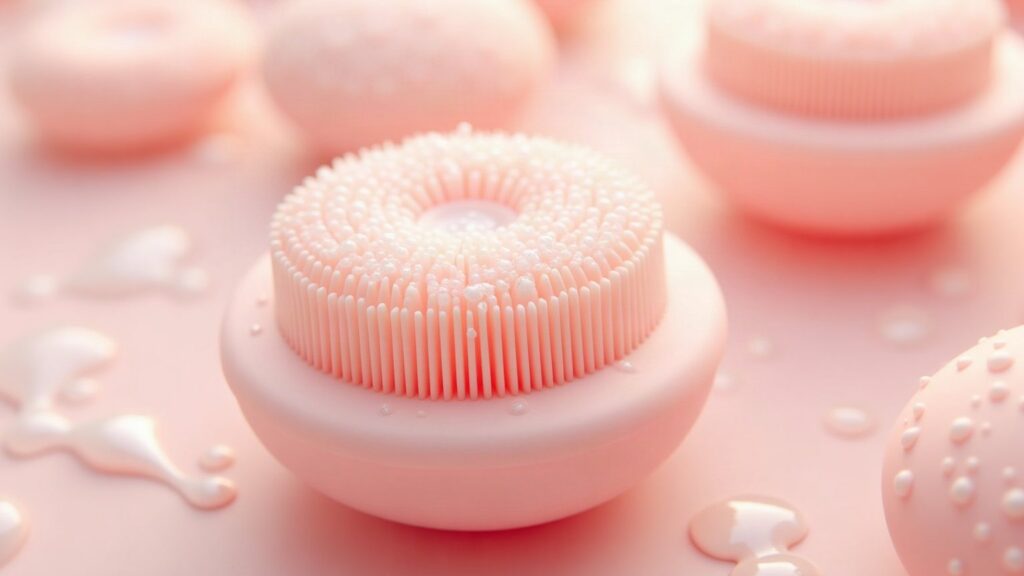
    Close-up of the silicone touchpoints of a facial cleansing brush covered in water droplets

    The six brushes in detail

    EZBASICS: silicone without the luxury price

    EZBASICS lists ultra-soft silicone, 5 speeds, IPX7 waterproofing for the shower, and induction charging on a stand: a full 3-hour charge is rated for about 200 uses. No brush head ever needs replacing. $22.99 (checked October 21, 2026), 4.6/5 on 12,605 ratings, sold by Amazon. Best for: anyone who wants silicone and a gentle start at the lowest speed.

    COSLUS spin brush: the low-cost classic

    A rotating brush with 2 speeds (low for daily cleansing, high for exfoliating), supplied with a silicone head for sensitive skin and bristle heads for a deeper clean. It runs on AA batteries (not included), and COSLUS advises against fully submerging it. $12.99 (checked October 21, 2026). Best for: a small budget and skin with no particular sensitivity.

    PMD Clean: the premium upgrade

    PMD Beauty’s silicone brush uses what the brand calls SonicGlow technology, 7,000 vibrations per minute, with four modes and an anti-aging massage side for serums and moisturizer. It’s waterproof and sold by Amazon.com. $99.00 (checked October 21, 2026), 4.4/5 on 1,897 ratings. Best for: anyone who wants a well-known US brand and a spa-style device for years.

    CLSEVXY 5-head set: try every head

    Five interchangeable heads (two bristle, one silicone, a makeup-removal sponge and a rolling massage head), 2 speeds, IPX5 water resistance, 2 AA batteries not included. $8.99 (checked October 21, 2026). Best for: figuring out which texture your skin likes before investing more.

    FOREO LUNA 4 go: the travel icon

    FOREO lists a 2-zone silicone brush with 8 T-Sonic intensities and a firming-massage mode, and its manual gives a 100 Hz frequency. The brand says it removes “99.5%” of dirt, oil and makeup residue in a minute; that’s FOREO’s claim. Its rating on this listing is the lowest of the six, 3.4/5 on 114 ratings. $63.99 (checked October 21, 2026), sold by Amazon. Best for: travelers who love the brand.

    PRITECH silicone: the cheapest silicone

    Soft silicone bristles, 5 vibration levels (1 to 3 for cleansing, 4 and 5 for massage), a metal end that heats to a steady 104 °F (40 °C) for applying skincare, USB charging and a stand. $9.99 (checked October 21, 2026). Best for: trying silicone for under $10.

    Who should skip it

    • If you have active eczema, psoriasis or a rosacea flare, leave the brush aside until your dermatologist says it’s fine.
    • If you have acne-prone skin, the AAD suggests cleansing with your fingertips; ask your dermatologist before adding a tool.
    • If your skin is very reactive, choose silicone and the lowest speed, a few times a week.

    Real cost and how often to use it: what the sources show side by side

    The real price is a two-year price. Upfront, the COSLUS costs $10 less than the EZBASICS ($12.99 vs $22.99, prices checked October 21, 2026). But at the 4-month replacement pace Beurer recommends for bristle heads, a bristle brush needs about five new heads over two years, plus AA batteries: as soon as a head costs more than $2, the spinning brush ends up costing more. No listing does that math; you only see it by putting price and upkeep side by side.

    Brands and doctors don’t agree on frequency. Brands encourage daily use, sometimes morning and night. Medical sources are more cautious: for acne-prone skin, the American Academy of Dermatology recommends using your fingertips, since tools can irritate; the National Rosacea Society advises against abrasive accessories and rubbing. Our take: the brand’s frequency is a maximum, not a target. Start at the lowest setting, a few times a week, and work up as your skin enjoys it.

    How we pick a facial cleansing brush

    1. Silicone over bristles, so you never buy replacement heads. 2. Several speed levels, so you can start very gently. 3. A waterproof, rechargeable body you’ll actually use every day.

    Good to know before your first use

    Makers of these brushes typically ask you not to use them on broken skin, open wounds, irritated or diseased skin, or right after sun exposure, and never dry or around the eyes (see for example the Beurer manual: no more than 20 seconds per area).

    FOREO asks users with a skin condition to consult a dermatologist first, to stop at the first sign of discomfort, not to exceed 3 minutes and to avoid the eyelids (FOREO manual).

    Acne, rosacea, eczema or reactive skin: these precautions apply to you directly. If you have concerns about your skin, ask a dermatologist before your first use; the manufacturer’s instructions always come first.

    FAQ

    Can I use a facial cleansing brush every day?
    Brands like FOREO recommend it, sometimes morning and night. Medical sources are more cautious: start a few times a week and stop at the first sign of discomfort.

    Silicone or bristle: which facial brush is more hygienic?
    Silicone washes with soap and has no head to replace; Beurer says to change a bristle head every 4 months. “35 times more hygienic” is a FOREO claim.

    Is a facial cleansing brush OK for acne or rosacea?
    Go carefully. The AAD recommends fingertips for acne-prone skin, and the National Rosacea Society advises against abrasive tools and rubbing. Ask a dermatologist before you start.

    What cleanser should I use with a silicone brush?
    A gel face cleanser. FOREO advises against clay-based or silicone-based cleansers and scrubs, which can damage the touchpoints.

    Are silicone face brushes worth it?
    For most people, yes: no heads to buy, easy to clean, and gentle settings. The EZBASICS gives you that for $22.99 (checked October 21, 2026).

    Our verdict

    Our top pick is the EZBASICS silicone facial cleansing brush: $22.99 (checked October 21, 2026), no heads to buy ever, 5 speeds and a waterproof, rechargeable body. It’s one of the easiest, most affordable upgrades you can make to your nightly routine. The COSLUS spin brush ($12.99, checked October 21, 2026) is a great deal for skin that isn’t sensitive, replacement heads aside. Want the premium experience? The PMD Clean ($99.00) is the upgrade. See also our guides to the best lighted makeup mirrors and the best electric razors for women. All our recommendations are on Our picks.

    Sources (checked October 2026):

    How we work: this article cross-checks manufacturer specs, the independent sources above and buyer reviews, with prices and ratings read on Amazon.com on October 21, 2026. We found no independent lab test of these exact models. We did not test these devices ourselves.